
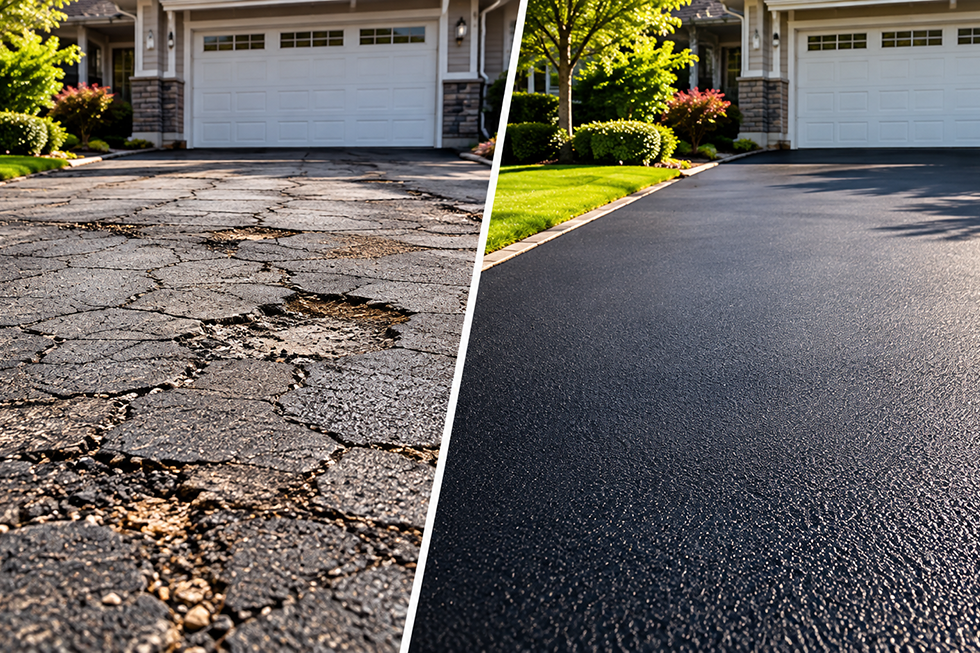
Driveway Resurfacing vs. Replacement: Which One Actually Saves You Money?
Every asphalt driveway reaches a point where you see a series of cracks near the garage, an old pothole, or maybe the blacktop has lost its luster and turned to gray.
The question then becomes: Resurface or replace?
It’s a matter of money. Replacing is more expensive than resurfacing (obviously). But you have to consider how much the job will cost you in the next decade, not just the one it’s in now. The underlying condition of your driveway is a big factor in the decision, which can’t be evaluated simply by looking at the top.
This is all you need to know!
What resurfacing actually involves
Finally, the resurfacing method implies repaving an existing driveway with a new layer of asphalt. During the process, the old road surface is cleaned and repaired (sealing cracks, depressions, and rough edges). After that, the fresh asphalt layer is placed on the top of it and rolled.
Due to the absence of the need for excavation, this method is the fastest and uses the least labor and materials.
At the same time, one should state that resurfacing is appropriate only in the case when the current driveway is satisfactory. Otherwise, it will be better to remove it completely and lay a new one instead of repairing the old one. This way, the money will not be wasted on fixing defects that will be soon damaged by the new asphalt layer. A new road surface made of asphalt is similar to painting on a wall — in both cases, the top layer can hide only minor flaws.
What replacement involves
Replacement is the process when old asphalt is removed and the driveway is reconstructed on its foundation. The workers eliminate the worn-out material, examine the ground and the gravel layer beneath it, resolve the issues discovered, compact the new base course, and paved the surface with asphalt.
Hence, this method is usually more expensive since it includes removing the previous asphalt, reconstructing the foundation, and paving the new road surface. Though it is more costly, it is the only solution when the problems are found in the ground or the gravel layer.
The base decides everything
The base is the compacted gravel layer upon which your asphalt is laid. It supports the weight of your vehicles and holds the surface in place. When it is in good condition, the asphalt layers above can withstand a lot of punishment and still be repaired or resealed. When it fails, everything above it suffers.
This is why two driveways that look similar can need completely different work. One has a solid base with a worn-out surface, and the other has a failing base that’s slowly showing through the cracks. Only a close look on site tells you which one you have.
Signs resurfacing makes sense
Resurfacing is usually a good call when:
- The cracks are thin and scattered rather than connected in a web
- The surface is faded, rough, or worn but still feels firm and level
- Problems are limited to a few small areas
- Water runs off properly and doesn’t sit in puddles
- The driveway doesn’t have sunken or shifting spots
If that sounds like your driveway, resurfacing can give you a smooth, dark surface for a lot less than a full rebuild.
Signs you should replace it
Replacement tends to be the smarter move when you see:
- Cracks that look like alligator skin, with small interlocking pieces
- Sunken areas or spots where the surface has dropped
- Potholes that keep returning after you patch them
- Water that pools in the same places every time it rains
- Large sections that feel soft or move under weight
- Edges that are crumbling away
These are usually signs that the base has failed. Putting new asphalt over a failed base is a bit like fixing a leaky roof by repainting the ceiling. It looks better for a season or two, and then the problem comes right back.
Why the cheaper option can cost more
Here’s a situation we see a lot. A homeowner has a driveway with obvious base problems and picks resurfacing because the quote is lower. It looks great for a year. Then the same cracks reappear, the same low spot sinks again, and eventually they’re paying for repairs, then maybe another overlay, and finally a full replacement anyway.
At that point they’ve paid for the same driveway two or three times.
The opposite mistake happens too. Someone with a sound base gets talked into a full replacement they didn’t need, and they pay for excavation and a new foundation that was perfectly fine.
The goal isn’t to pick the cheapest job or the biggest one. It’s to pick the one that fixes the actual problem.
Why rain and cold matter around here
In Vancouver, Richmond, Burnaby, and the Lower Mainland as a whole, water is the number one enemy of asphalt. Water that runs down into cracks and becomes absorbed into the base of the asphalt can cause major problems due to freezing and thawing during the winter months. Small cracks in the asphalt during the month of October can turn into gaping holes by the month of May.
The main difference between the two methods has to do with drainage. Improper drainage of water off of your driveway should be addressed and remedied before any paving takes place, or else the newly paved surface will be subjected to the same problems.
Sealing and maintenance are a huge factor in the longevity of your asphalt. Sealing your asphalt every few years will allow you to prolong the life of your asphalt, as well as resist the damaging effects of moisture, (Depending on which method you choose.)
What to expect from an on-site assessment
A good contractor won’t quote a driveway from a photo or a drive-by. They’ll want to walk it. A proper assessment looks at things like:
- How widespread and deep the cracking is
- Whether the surface is firm or soft in the damaged spots
- How water moves across and off the driveway
- Whether there’s any sinking, heaving, or edge damage
- The slope and grade
- How the driveway is used, like heavy vehicles, tight turns, or steep sections
- Your plans for the property, such as selling soon or staying long term
Based on that, an honest contractor should tell you which option makes sense, and be upfront if the answer is the less expensive one.
How to compare quotes fairly
If you’re getting more than one quote, make sure you’re comparing the same thing. Ask each contractor:
- Is this resurfacing, a partial replacement, or a full replacement?
- What will you do about the base and drainage?
- How thick will the new asphalt be?
- Who does the work, your own crew or subcontractors?
- What warranty comes with the job, and what does it cover? Get it in writing.
- How long before we can drive on it?
A much lower price often means something is being left out. It could be less base preparation, thinner asphalt, or no drainage fix. Those shortcuts don’t show up on paving day. They show up in year two.
After the work is done
Regardless of what service you choose, newly laid asphalt requires some love. Steer clear of it for the first day or two, as the crew lays down instructions, and try not to turn your wheel while your car is off, as this can cause soft spots in the material. It also needs to be hardened over the next few months, so don’t panic if it feels a little squishy on a hot day in the early going.
Once that’s done, fill those new cracks early and often, make sure to keep water from pooling on it, and get it sealed every couple of years or so. A little maintenance goes a long way in the life of your asphalt, compared to having to re-surface or replace it.
So, which one saves more?
If your base is sound and the damage is superficial, resurfacing will almost always save you money.
If the base is compromised, or the damage is a result of water intrusion and/or structural damage, replacement is almost always the best option, even though it may seem expensive at first.
And if you’re unsure which you have, don’t worry; you’re not alone. Most people can’t tell the difference, and that’s why we offer assessments.
Get a straight answer on your driveway
At Nasib’s Asphalt Paving, our own crews handle every job from quote to finish, and we serve driveways across Vancouver, Richmond, Burnaby, New Westminster, and the North Shore. We’ll look at your driveway in person, tell you plainly whether it needs resurfacing, replacement, or just some maintenance and repair, and give you a free quote with no pressure.
Call 778-953-2065 or request a free quote today.